
Hot Tub Pump Replacement Cost in 2026: A Real Breakdown
What it really costs to replace a hot tub pump in 2026 — jet vs. circulation, single vs. dual speed, parts, labor, and when a rebuild is the smarter spend.
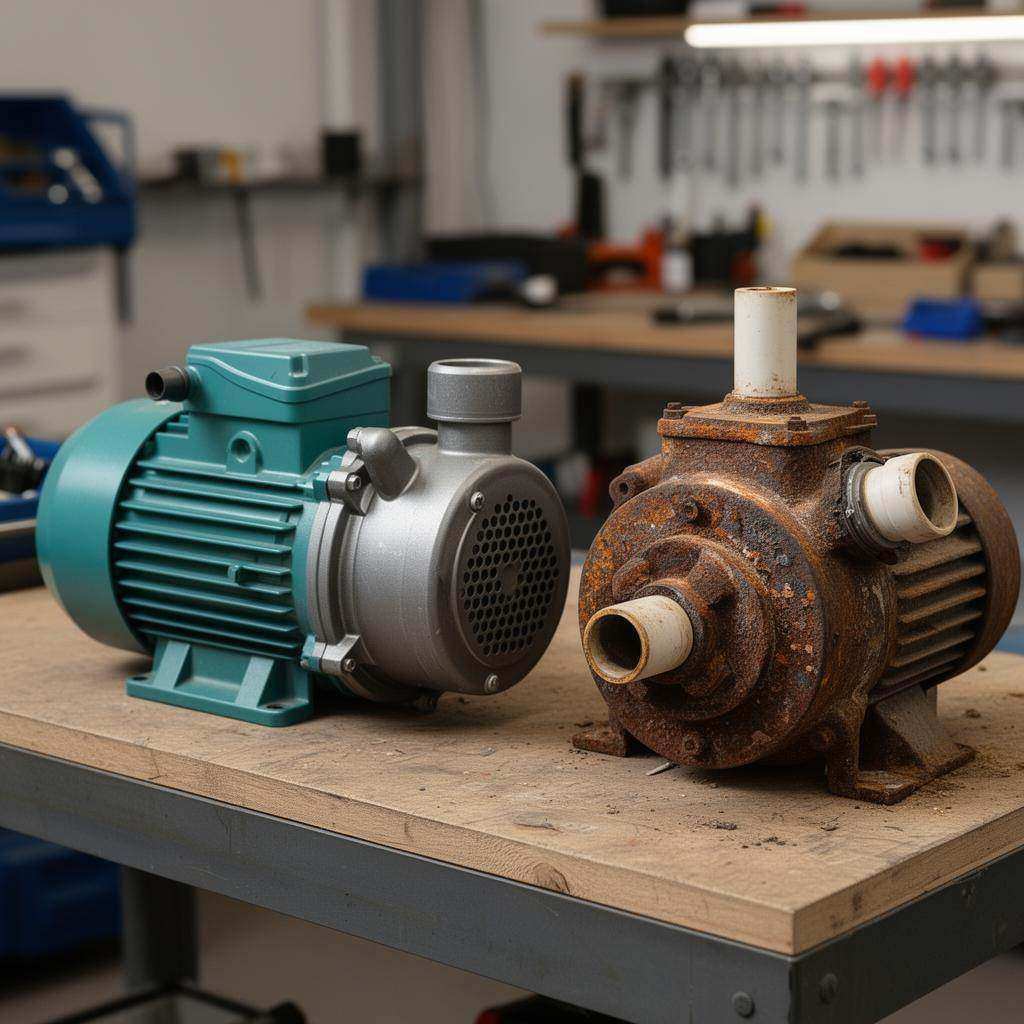
After the heater, the pump is the most common big-ticket hot tub repair we run. It's also the one where homeowners get the most wildly different quotes — anywhere from $250 to $900 for what sounds like the same job. This guide breaks down what's actually being priced, why two pumps can cost $200 apart in parts, and when rebuilding beats replacing.
The short answer: typical 2026 pump pricing
Most homeowners in the U.S. pay $400 to $750 for a complete hot tub pump replacement, installed, with a written workmanship warranty. The range covers:
- Diagnostic / trip fee: $79 – $149 (often waived on approval)
- Single-speed jet pump (2.0 HP): $140 – $260 in parts
- Dual-speed jet pump (2.5–3.0 HP): $220 – $380 in parts
- Circulation pump (24-hour low-flow): $160 – $290 in parts
- Labor: $150 – $260, depending on access and plumbing
A quote substantially below that range usually means an undersized aftermarket motor, a rebuild instead of a full replacement (not always a bad thing — see below), or a tech skipping a union/gasket swap.
What drives the cost
1. Single-speed vs. dual-speed
Older spas often have a separate circulation pump (running 24/7 on low watts) and one or two jet pumps that fire only when you press a button. Newer spas often combine these into a dual-speed jet pump that runs on low for filtration and switches to high for therapy.
Dual-speed pumps cost more in parts and require more careful wiring during install. A "$199 pump online" is almost always single-speed and won't match the wiring of a dual-speed install.
2. Horsepower and wet-end size
The number on the side (1.5 HP, 2.5 HP, 4.0 HP) describes the motor, but the wet end — the plastic housing the impeller spins in — is what makes the pump physically fit your plumbing.
A wet end is described by its inlet/outlet size (typically 2", 2.5", or "side discharge / center discharge") and its flange pattern. Buying the right horsepower but the wrong wet end means a pump that doesn't bolt up to your plumbing.
3. Voltage and amperage
Spas run on either 120V (smaller plug-in spas) or 240V (most full-size in-ground or hardwired spas). A pump rated for the wrong voltage either won't run or will burn out instantly. Amperage also has to match what the control pack can switch — a too-large pump on an undersized relay will weld the contacts shut.
4. Brand and OEM vs. aftermarket
Top motor brands (Waterway, Aqua-Flo (Gecko), LX Whirlpool) are reliable and have a strong parts pipeline. OEM-replacement pumps cost 20–40% more than generics but typically last 8–12 years vs. 3–6 for cheap aftermarket.
For a spa you want to keep, OEM-quality is almost always worth it.
5. Access and plumbing condition
A spa with the equipment bay door at front, dry foam, and accessible unions can be swapped in 60 minutes. A spa where the pump is buried behind plumbing, the unions are seized from age, and the foam has to be carefully cut back can take 3 hours.
Why pumps fail in the first place
Knowing the failure mode tells you whether to rebuild or replace:
Seal failure (rebuild candidate)
The mechanical seal between the wet end and the motor shaft is a wear part. When it fails, water drips from the front of the motor onto the bearings, which fail next.
If caught early (a drip, not a flood) the seal is a $35 part and a 30-minute job. If the bearings have already grown stiff or noisy, replace the whole pump.
Bearing failure (replace)
A pump that grinds, growls, or squeals at startup has worn bearings. They can be repressed, but on a 6+ year old pump the motor windings are usually next on the failure list anyway. Replace.
Capacitor failure (cheapest fix)
The start capacitor is a small cylinder on the motor that gives the pump its initial torque to spin up. When it fails, the motor hums but doesn't spin. Capacitor replacement is $25–$60 in parts and a 15-minute job — by far the cheapest pump-related repair.
Burned windings (replace)
If a pump has been dry-fired or run with restricted flow, the motor windings overheat and char. Smell of burnt insulation, blackened motor end — definite replacement.
Wet end crack (replace wet end only, sometimes)
If the motor is healthy but the wet end is cracked or leaking at a fitting, just the wet end can be replaced for $80–$160 in parts. This is the most common "rebuild instead of replace" scenario on newer spas.
When a rebuild beats a swap
Three scenarios where rebuilding is the smarter spend:
- Failed seal on a pump less than 4 years old — $35 part, $120 labor, you get years more life
- Cracked wet end on a recent OEM motor — $80–$160 part, $150 labor
- Bad capacitor on any age pump — $25–$60 part, often a $99 trip fee
We'll quote the rebuild side-by-side with replacement when it makes sense. It saves you $300+ and is honest work.
When replacement is the right answer
- Pump is 8+ years old and any major component has failed
- Multiple failure modes at once (e.g., leaking seal AND noisy bearings)
- Wet end shape or fitment has changed in newer pump versions, making rebuild impossible
- Burned windings or rotor damage — these are not rebuildable in any practical sense
DIY vs. professional
Pump replacement is borderline DIY territory. The mechanical work is straightforward — drain to below the pump, open the unions, disconnect the wiring, swap pumps, reconnect, prime, restart. But:
- It involves 240V wiring that has to land on the right terminals
- The GFCI must be tested under load after install
- A pump installed with the wrong wet end or orientation can damage the control pack
- An incorrectly torqued union cracks the housing the moment you re-energize
If you've done electrical work before and have proper tools, it's a 2–3 hour project. If not, a pro is $400–$700 well spent — and it'll be warrantied.
What a professional pump quote should include
Whether you hire us or someone else, a quote should specify:
- Pump brand, horsepower, voltage, wet-end size, and discharge orientation
- New unions and O-rings (these are $5 in parts and always need to be swapped)
- Test under load with GFCI verification
- Written workmanship warranty of at least 90 days
- Parts warranty of at least 12 months
If any of those are missing, get a second opinion.
Need a pump diagnosed?
We carry the most common Waterway, Aqua-Flo, and LX pumps on every truck. Diagnostics are flat-rate, waived when you approve the repair, and 90% of pump jobs are completed same-day. Call 24/7.